

When Our Choices Ripple Forward
Ahaz chose to trust Assyria instead of God, and at first it seemed to work—the threat in front of him was removed. But Isaiah shows us that the consequences of that choice did not end with Ahaz; Assyria would eventually sweep into Judah as well. We live in such a small piece of time, and this made us stop and consider how choices made today can ripple much further than we can see.
Read the transcript instead
Good morning. Today we are in Isaiah 7:17–8:8.
All of the resources that I've been reading through and trying to utilize to grasp what we're reading in Isaiah really seem to connect that whole section together.
I apologize. I've been sick, so my voice is probably a little bit more raspy than usual.
And this section has a lot going on in it.
And we start in 7:17 with the Lord saying:
"The Lord will bring on you, on your people, and on your father's house such days as have not come since the day that Ephraim separated from Judah—the days of the king of Assyria."
And so we start with King Ahaz, who chose to turn to the king of Assyria instead of to God, which is what we read earlier in Isaiah 7.
And then we went and read 2 Kings 16 to sort of dive into that deeper.
And now we're coming back to this period, which transitions from Ahaz's time to King Hezekiah's time, and it all is sort of intermingled here in Isaiah, and it's sort of confusing.
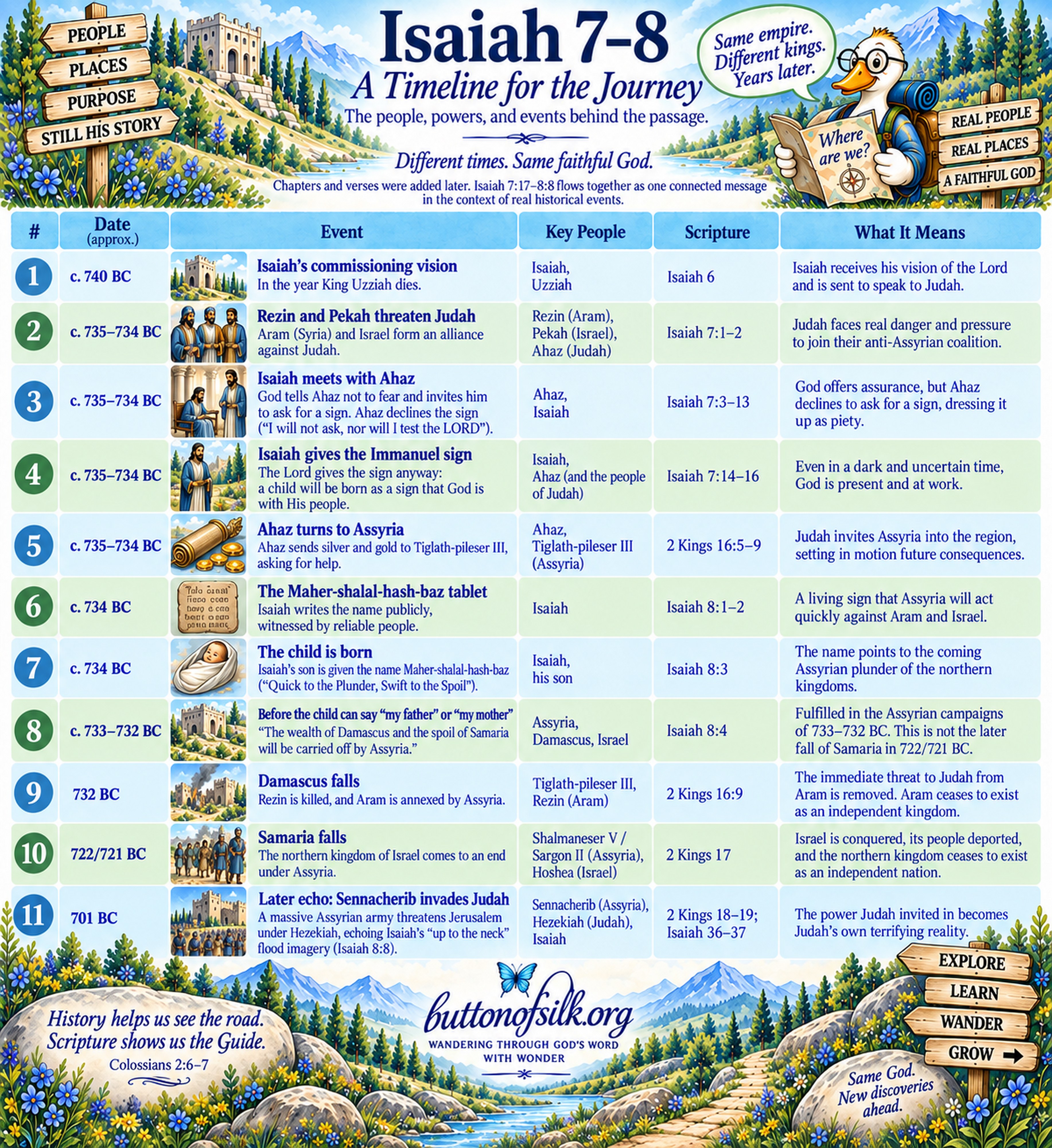
So I did work with ChatGPT and Claude—both are AI generators—to come up with a timeline for these parts of Scripture to help sort of explain the timeframe that we're dealing with.
Because not only is this dealing with Ahaz and him being worried about those two people coming to attack him—King Rezin, and then the king of Israel coming and attacking him—that he, instead of turning to God, turned to Assyria.
And that is going to have far-reaching effects on everything that we're doing and reading in this section of Scripture.
And so, yeah, we hear about all of that happening.
And I don't know. Maybe it's just because my brain is sick, because I have this head cold, or because there's other stuff going on, but I've just sort of sat here staring at all this being like, "Wow. What the heck?"
Because then in 8:1, the Lord says to Isaiah:
"Take for yourself a large tablet and write on it in ordinary letters: Maher-shalal-hash-baz."
And then he has that witnessed.
So in verse 2 it says:
"And I will take to Myself faithful witnesses for testimony, Uriah the priest and Zechariah the son of Jeberechiah."
So that was done.
And then, again, still during King Ahaz's time, Isaiah and his wife had a son who he named Maher-shalal-hash-baz.
And then that is talking about when Damascus and Samaria were taken care of by the king of Assyria during Ahaz's time.
But then he moves on into this next period of time that happens during King Hezekiah, which you can read about in 2 Kings 18:13–16.
And you can sort of read further along in there, past 16, to start seeing how it's all interconnected.
And then the verses that really stuck out to me were 8:6–8:
"Inasmuch as these people have rejected the gently flowing waters of Shiloah and rejoice in Rezin and the son of Remaliah; now therefore, behold, the Lord is about to bring on them the strong and abundant waters of the Euphrates River, that is, the king of Assyria and all his glory; and it will rise over all its channels and go over all its banks. Then it will sweep on into Judah, it will overflow and pass through; it will reach as far as the neck; and the spread of its wings will fill the expanse of your land, Immanuel."
And we can, again, go read and understand what was happening in there back in 2 Kings 18.
So there's just a lot going on here.
And just how—I think the thing that stuck out to me is Ahaz's choice to not trust in the God of Israel.
Instead, he chose to trust in man, which worked at first.
Assyria came in, helped him turn these people away, and I'm sure he's like, "Yay! Look at political alliances and how all of that worked well together."
But then we just see that the consequences of that choice reach much further into the future and have such a horrible effect on Judah, even into the next king's reign and the choices that the next king makes.
And that just—you know, not only when we pray may we not see the fulfillment of those prayers during our lifetime. That can happen later on.
But we also can't always predict how other choices that we make are going to have far-reaching consequences for our family later on, after we're gone.
Like, we live in such a small pool of time, but our choices and decisions ripple out far beyond just our timeframe.
And wow.
If that doesn't stop and make you—make me—think about my choices and have sadness over things that I have done in my past, knowing that there could be these consequences going forward.
Lord, would have mercy.
Oh, there's a lot here.
And so I—I hope that the graphic I created can help, or help you see and organize the information that is here and how it flows through a larger time than we might have been expecting.
But there are lessons in this, even without fully understanding all of that background—what God has for us, and for us to meet Him here.
And for me, I really see, again, His sovereignty, His justice prevailing against an evil man in King Ahaz.
I thank You for who You are.
Thank You for Your wisdom and Your guidance, and for just helping us wander through this more complicated section of Isaiah and helping us find our way through it, Lord.
And that You meet us even when it's confusing or not as walked out as it was when we were in John, Lord.
That, yeah, You still give us the information. It's just sort of connected throughout more books of the Bible, and how we need to wander into them to find and understand what all is going on.
But that You meet us even in the smaller sections of verses and reveal Yourself to us in ways for us to think about our life now, so many years removed from Ahaz.
Oh Lord, I just ask that You'd be with us as we go out and do the things You've placed in front of us.
As we have people and tasks placed in our path that You have ordained, that we would seek You and know what to say yes to and what to say no to.
Oh Lord, it is in the precious name of Jesus I pray. Amen.
All right. Thank you for joining me as we wander through God's Word with wonder.