

When Human Authority Shapes How We See God
This reflection touches on abuse and misused authority. If that is close to home, there is help and a list of resources.
Isaiah repeatedly says that God's hand is still stretched out and that the people did not turn back to the One who struck them. For someone whose experience of human authority has included abuse, control, or manipulation, those words can be difficult to hear without bringing human experiences into how we understand God. This passage made us stop and ask what changes when we begin with who God actually is.
Read the transcript instead
Good morning. Today we are in Isaiah 9:8–10:4.
And when I say that I have been on a journey for this for the last three days of praying and working through what my struggles are with this—man, have I.
Have I gone for a long mental hike.
We have circled a lot of different things, and I think I finally came to understand my struggle with it.
So this may take a direction that nobody else would have ended up on, but it was important for me to stop and really understand what I was struggling with when I heard about God's judgment and His righteousness, and why every time I came across that, I was having this, like, internal crunch.
And it finally dawned on me that it's because of my experience with other humans.
And some of those relationships have been abusive, domineering, controlling.
That's really affected me, and it has really affected how I look at Scripture.
So we're going to dive into the Scripture, a few of the things that jumped out, and then we're going to spend a little bit of time walking through how the same words can have a different reality, and why God's discipline and misused human authority are not the same.
And it has helped me come to this place of peace.
And I hope that maybe others who have gone through abuse or spiritual abuse—that's so heavy.
And first, I want to acknowledge that you've gone through that.
But I also want you to know that God is good, and He is righteous, and His discipline is not the same as what we experienced at the hands of other humans.
Four times, at least, there is a sentence that is repeated.
And the different versions of the Bible have different translations, right? Have different ways of saying that.
And in the NASB, New King James, and the King James, it says, "And His hand is still stretched out."
The CSB says, "And His hand is still raised to strike."
And the NLT says, "His fist is still poised to strike."
Why?
Well, verse 13 in chapter 9 gives us that:
"Yet the people do not turn back to Him who struck them."
That's what the NASB says.
And then the New King James Version says:
"For the people do not turn to Him who strikes them, nor do they seek the Lord of hosts."
So in our human relationships, if somebody has actually hit you, the incorrect thing is to turn and run back to them, right?
Like, that continues the abuse. That continues the incorrect behavior that's happening, right?
So why is it different when God does it?
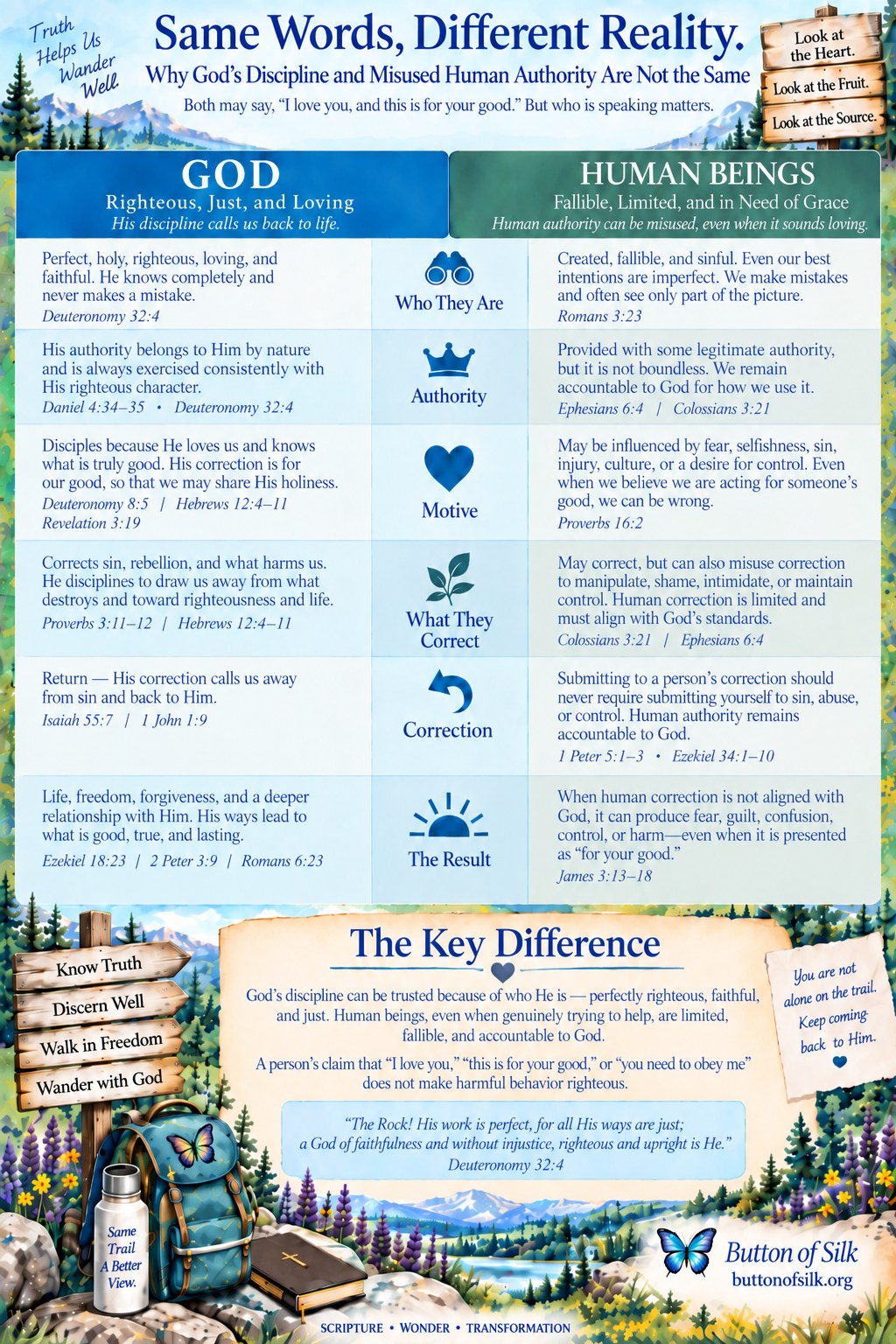
So I created an image on the website, and I'm sort of going to walk through it a little bit.
There's verse references on it that you can go look at on your own. I don't want to make this very heavy by citing all of them here, but I do have them on the graphic that's on the website.
And so on one side it says:
God: He is righteous, just, and loving. His discipline calls us back to life.
And human beings: fallible, limited, and in need of grace. Human authority can be misused, even when it sounds loving.
So the first stop we make is: Who God is.
Perfect, holy, righteous, loving, and faithful. He knows completely, and He never makes a mistake.
Meanwhile, humans are created, fallible, and sinful. Even our best intentions are imperfect, and we make mistakes, and we often only see part of the picture.
The next one is authority.
His authority belongs to Him by nature and is always exercised consistently with His righteous character.
On the human side, we are provided with some legitimate authority. We are allowed to discipline our children and to correct actions that are wrong, but it is not boundless. Authority can be misused, even when it sounds loving, and it needs to line up with Scripture, right?
So that's important there.
And there's something else important here when it comes to spiritual abuse.
Spiritual abuse is when God's Word is taken out of context and then applied in a way with authority, and then we're told, "If you believe any different than me, then you're wrong."
That's sort of the connotation here.
It's used as, "This is my version of it, and only my way of looking at it matters, and if you look at it any other way, then you're wrong."
And I hope that makes sense.
There are many ways that that can come across, but ultimately God is the final authority, not man.
And by man, I mean human, because women can be just as awful as males can be.
The line that we have here is what they correct.
God corrects sin, rebellion, what harms us.
He disciples us. He disciplines us. Sorry.
He disciplines us to draw us away from what destroys and towards righteousness and life.
Humans may correct, but can also misuse correction to manipulate, shame, intimidate, or maintain control.
Human authority can be misused, even when it sounds loving.
Again, God is the ultimate authority, not man.
Correction. Return.
God's correction calls us away from sin and back to Him, while submitting to another person's correction should never require submitting yourself to sin, abuse, or control.
Lastly, we have the result.
When God disciplines us and we repent and turn back to Him, we are given life, freedom, forgiveness, and a deeper relationship with Him.
His ways lead to what is good, true, and lasting.
When human correction is not aligned with God, it can produce fear, guilt, confusion, control, or harm, even when it's presented as "for your good."
The key difference that we have is that God's discipline can be trusted because of who He is: perfectly righteous, faithful, and just.
Human beings, even when genuinely trying to help, are limited, fallible, and accountable to God.
A person's claim that "I love you," "This is for your good," or "You need to obey me" does not make harmful behavior righteous.
Deuteronomy 32:4 says:
"The Rock! His work is perfect, for all His ways are just; a God of faithfulness and without injustice, righteous and upright is He."
That brings me back to understanding what's happening in Isaiah—the judgment of Israel that's happening, but later, when God's judgment comes down on Assyria, as in what we walked through with Nahum a long time ago and probably need—I'll do it again.
I cannot judge God's correction by the standard of humans who have been abusive, coercive, manipulative, and controlling.
If I am going to understand God's judgment, and in particular since we're in Isaiah, I have to begin with who God is, and then that helps me understand what He's doing.
We also have the finalized hope that Isaiah keeps pointing us to, right?
Like, we live on the other side of Christ's life, death, and resurrection.
Isaiah just was getting to see it. He did not get to experience it.
And yet we still have a forward hope for us to look forward to that happens in Revelation, which is a little bit further down the road.
And I think we might do another discussion about that, in particular how God's wrath doesn't change throughout Scripture, but the solution that He gives us in Christ changes some things for us.
So I hope that you have enjoyed wandering through God's Word with me.
I hope that this has helped you maybe understand something that you were struggling with if you've had a history in any way similar to mine.
I would love to hear your thoughts.
I would love to hear what stood out to you.
Oh, Heavenly Father, You are perfect.
You are good.
You are holy, and You are just.
Thank You for that.
Thank You.
Thank You for showing us who You are compared to who we are as humans, and why You have the ultimate authority and humans, we do not.
Thank You for that, Lord.
Please be with us as we go out and do the things You've given us to do, we love on the people in front of us, and as we go out and honor You and be a light for the world.
Lord, it is in the precious name of Jesus I pray. Amen.
Thank you for joining me today as we wander through God's Word with wonder.